it takes a villars

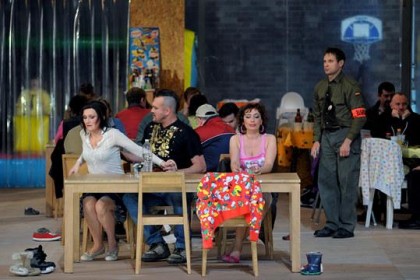
Heldentenordiva Jon Villars (center, in mohawk) “basically fired himself by walking off the stage” at a public dress rehearsal for the Canadian Opera Company’s production of Fidelio. According to a report in The Globe and Mail, Villars stormed off stage immediately after conductor Gregor Buhl “loudly sang out a few phrases of the tenor’s part” during the second act. Jumping in as Florestan will be Icelandic tenor Jon Ketilsson and later Richard Margison.
Am I wrong? Was’nt Villars the Tristan in that awful Tristan & Isolde video with Waltraud Meier where the lovers in Act 2 sat on a sofa with yellow daisy patterns ? If so, there was no ‘love going on’….’just a big unmusical conflicted shouting match’ between two singers. Tempos also, were all over the place.
What we are in short discussing is ‘Professionalism’. The ability to get up on stage and deliver what people should expect out of an artist. Is there no such thing as pre performance ‘consultations’ between singers and conductor if one or the other has concerns? Sure someone can have an ‘off night’ but when they become frequent, covered up with tantrums, or a myriad of sickness excuses: it is time for them to pack the bags and leave the ‘scene’ quietly and gracefully. A defiant ‘fingers up Florestan’ is not exactly what Beethoven had in mind.
The funniest incident similar to the above mentioned: A day time dress rehearsal of Verdi’s Otello with a audience mainly comprised of school children ‘getting to know Opera’. Except the kids tended to chatter throughout. By the time Desdemona was ‘strangled’, they were still chattering. The soprano then rose up from her bed and called out “Will you lot, fuckin’ shut up”!!! The Opera then continued to the finish.
turandot: I suppose you’re right, but this abstract musing has led us rather far afield from the original question, which is what went wrong in the Fidelio.
One big problem here is that atavism the “public dress rehearsal,” which generally means an extra performance that the singers grudgingly do for free, pressured to sing full voice. The conductor and stage director too are supposed to take one for the team and relinquish their prerogative of using rehearsal time to stop and work through troublesome parts of the piece. Instead, the focus is on entertaining the “invited” audience with the knowledge that they’re about to go gossipping about the show all over town and all over the web.
On the other hand, La Cieca doesn’t know the run-up to the climactic event here: it may be that Villars had been in full meltdown for a week or more, and the “walkout” served as a useful excuse for the opera company to can him. It remains La Cieca’s opinion, though, that a walkout or firing so late in the game represents a major failure on the part of the system. The purpose of an opera company is to present opera, not excuses.
“One big problem here is that atavism the “public dress rehearsal,†which generally means an extra performance that the singers grudgingly do for free, pressured to sing full voice.”
This is absolutely true. This also applies to concert work where you’ll have the final dress rehearsal on the MORNING OF the performance with an audience in attendance. Imagine being expected by management of an orchestra to sing a Verdi Requiem at 11 am in full voice, and then REPEAT it again that night. That’s just the tip of the iceberg. Conductors are generally more understanding about this predicament, but not always.
I’ll add that while I think the ultimate arrival of the final product is most hopefully an even exchange between artistic equals (meaning the conductor and singer), this frequently does NOT happen, and I will ALWAYS err on being on the side of the singer because the singer is the one on the stage having to make a nearly impossible job look easy.
Conductors CAN’T do our job, can I can fairly guarantee we would be able to do theirs.
This is a point frequently forgotten in the industry. Those people a singer is surrounded with during the rehearsal and performance process, and I mean everyone, from costume designer, to stage manager, to general director, to pit musician, to critic, and on and on and on would NEVER be able to do the job that we do on the stage. As in, it would be physically impossible for them to do. It feels very bizarre to be surrounded by people telling you what to do when they themselves could never do it. Is there any other industry quite like this where you have those who could never perform the tasks required attempting to demand things from those who can?
There is a point when you’ve been around long enough where you learn as a singer to listen to very few people. You learn to live in a protective bubble that very little penetrates, and with good reason. I personally allow maybe three people per gig to be part of the process for me, and one of those generally includes my manager who is my outside set of ears and my complaint box, so you can imagine that a conductor, a director, a coach, and many others who just love to be heard are going to have to have a very good reason to be heard by me.
As a singer, you learn to edit quickly and efficiently in order to survive. Sometimes this process runs into problems when a singer’s physical apparatus no longer works. Unfortunately, this is what sounds like is happening to Jon, and when the singer’s “bubble” is burst, things can go awry.
I’m not saying the singer is always correct, so don’t jump all over me about that.
Harry (#66): Aside from the fact that Jussi died in 1960 I refer you to Cornell McNiel’s account of the recording in Farkas’ biography “Jussi” in which he states that JB showed up for rehearsal on time and in shape anxious to do the recording. My point is very simply that Herr Solti when presented the opportunity to record Ballo with the preeminent Riccardo of his generation should have had the wisdom and humility to make allowances for a singer who admitedly could be difficult. In other words, in the persuit of art it’s ok to take a little shit.
Villars didn’t sing the Tristan opposite Meier. That was Jon Frederick West. He is even worse than Villars.
What do I think of Oren? I think he’s a pig. Conductors can be pigs too, with total disregard for the music, the singers or anything that is happening on stage. I agree that a conductor cannot do a singer’s job, but sometimes a conductor prevents a singer from doing their job. That is when singer star power can have its advantage. Unfortunately singer star power can wreak havok when the the conductor is the one who knows what he is doing. The one with the most talent should have the final say. Now who is going to decide that? That is when the general director is supposed to step in, but that requires real knowledge and musical sensibilities on the part of the general manager. How many general managers can really do that today?
Jon was my roomate in college…..oh the stories I could tell!!!!!!
“Florestan, although notoriously difficult like Leonore, is VERY short. The tenor doesn’t even come on until the second act, and then only sings one aria, a short duet, and an ensemble. It has resulted in many tenor disasters though which can be excruciating to sit through, either as fellow cast member or member of the audience.”
Actually, there is a bit more to the role than just an aria, short duet and ensemble. There is in addition the trio “Euch werde Lohn” with Leonore and Rocco and the quartet “Er sterbe!” with the trio characters plus Pizarro. Of course, Florestan is not a long role, particularly in the helden tenor fach, but it is tiring. I’ve only heard one tenor make it through the aria without losing steam or cracking – Anthony Dean Griffey was quite impressive in the role a couple of years ago in Seville.
I heard Jon Villars sing Bacchus in a concert Ariadne with the Minnesota Orchestra many years ago. Not a bad performance of a difficult role, although I agree with the assessment that the middle and lower voice are produced oddly. I was wondering what had happened to him, hadn’t heard or seen much of him in the last few years. I’m sorry that he felt the need to flip the bird while performing the role of Florestan. Beethoven’s Fidelio deserves more respect and that kind of behavior is uncalled for. If there is an issue, discuss the matter afterwards with the conductor and act like an adult. Respect the music, please.
Tim Comment 75…adding to your comments about Bjorling,rhe fact that I mentioned the year of recording ‘Ballo’ one year out (as 1961) is neither here nor there. From recording to its release can be a far duration. I believe that Decca faced a real crisis with Bjorling. It has been stated that he was found in his hotel absolutely depressed as well as ‘wildly blotto’. If someone is ‘a professional’, you deliver your contractual commitments. Bjorling was not fit to do the recording. I am sure that whatever Solti’s opinions may have been,they would not be the ONLY opinion that the Decca producers used to come to the final decision to remove Bjorling from the recording. Decca had a another ‘drop -out’ situation with Di Stefano from their Mefistofele (Tebaldi) recording. Whatever the cause, I do not know. Decca completed their Mefistofele with Del Monaco. Many years later, all of Di Stefano’s previous recorded contributions to the project were released by Decca on separate CD release.. Does anyone know the facts behind that Decca ‘Mefistofele -Di Stefano saga’?