

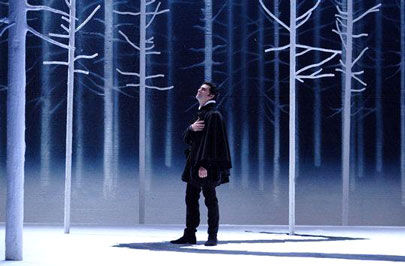
the spanish panic

New York-centric as she is, La Cieca cannot help but sulk when she hears that the Met is in line for Nicholas Hynter‘s “rather limited” staging of Don Carlo that opened last night at the Royal Opera House, Covent Garden.Â
According to Dominic McHugh, writing at musicalcriticism.com,
Nicholas Hytner’s new staging – a costly co-production with the Metropolitan Opera and the Norwegian National Opera – is, for me, a disappointment … [T]he production satisfies few of Verdi’s more interesting dramaturgical ideas, says nothing new about most of the themes elaborated in the libretto and strikes me as rather limited in its stagecraft.
Almost without exception, the big arias and monologues were delivered with no attempt at expressing the text, be it Elisabetta’s ‘Tu che le vanita’ or the King’s great soliloquy ….
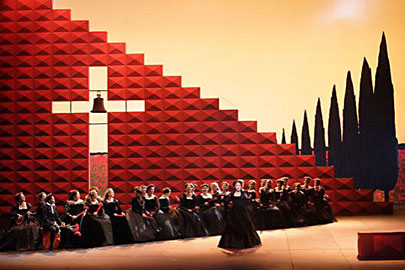
But for an opera which has such potential for beauty and grandeur, Bob Crowley‘s designs are curiously lacking in inspiration. Act I shows us white plastic trees, two white tree stumps and a piece of white sheeting on the ground to represent snow; the cloister of San Yuste is represented by a pitifully basic tomb with ‘Carlos’ written on the side; the wall in Act II, Part 2 looks as if it’s been made out of giant Lego bricks with a cross-shaped hole in the middle; and the King’s Study scene has rarely been so emptily or dully staged in my experience. All the symbolism has been too broadly painted – religion and the loneliness of power are represented but not explored to their full potential – and on the other hand, the loud shouting and jeering of the chorus during the condemnation of the heretics in Act III is wildly excessive …
On the other hand, Rolando Villazón wins enthusiastic praise for the “elegance of line” and “classical nuance” of his singing, which the reviewer found “deeply moving.” Not surprisingly, though, “Villazón was occasionally a little too neurotic in terms of acting.”
The Met Futures page is currently under construction, so La Cieca can’t check this, but it seems that Villazón’s Carlos is one element of this production that will not make the journey to New York. Instead, we get the plastic trees and the Lego cloister.
“Poplavskaya was a disappointment, through and through; the part may be a demanding one, but presumably ROH knew that already when they cast her to replace La Gheorghiu”………….Bollocks was she. At least she has the heft of voice to sing this role, rather than that insipid trout face soubrette, Gheorghiu. I have attended every performance so far and Marina has been phenomenal, unlike Rolando who has been booed at two separate performances already for his miniscule voice, squally top notes and ham dramatics.
Scotto exaggerates her career? Pfft. One of the greatest singing actresses ever. She didn’t manipulate anyone to stay at the Met/ James Levine wanted a real Italian reading and she had that and more. These know it all’s, bandy about their so called knowledge. She was and is a HUGE star among people who know voice and music can be magic.
Sondra? Never heard her sing in pitch so I do not know. Hideous colleague, used only because she is available. Wonder why.
Does anyone know if this will be broadcast?
Scotto manipulative?????maybe that is why both Pavarotti and Domingo, when celebrating their thirtieth aniversaries at the MEt cited working with Renata has the highlight of their met careers. Domingo said working with her on the Manon Lescaut was his highlight, and Pavarotti on the telecast of Boheme and Pavarotti said this even after his falling out with Renata over his behavior during the Gioconda in SF. Every singer who ever works with her is always amazed at what she has to offer. If she was so manipulative maybe she wouldn’t have been given the boot by the MET so unceremoniously without even a formal farewell. Maybe she would have been able to do recitals here or her Marschallin at NYCO if she had been a little more manipulative. She was basically blackballed in NY because of cruel press coverage at the time. According to the papers at the time she could do no right just as today according to AT of the NYT Fleming and Voigt can do no wrong. Scotto maintained an active career for many years throughout Europe and in other opera houses here in the States long after the MET decided she wasn’t welcome anymore. We missed out on our chance to see her Marschallin, Fedora or Kundry
well, in the above clip alone, Scotto’s forte top notes are wirey and out of tune – she’s clearly manufacturing a spinto-ish tone in an area of her voice that wasn’t naturally meant to produce that much sound. And, btw, this isn’t news to anyone who knows her voice and career – she beefed up a lyric-coloratura voice to sing Verdi/Verismo, and she paid for it.
As for Radvanovsky, it’s not perfect by any means, but it’s consistantly interesting, solid up to high E, can ride over the ensembles, and displays an attention to old school bel canto/Verdian singing – pianissimi, great portimenti, phrasing, etc. I’ll take that over Gheorgiu/Netrebka blech any day.
Radvonovsky has an even tone, but what language does she sing in???My biggest reason for not being a fan of SR is the total lack of characterization. It is just sound with no emotional weight or sense of character.
balabanov – you are right about Scotto’s wiry top notes and beefed-up middle. It was never a beautiful sound like Freni’s, but how did she “pay for it” – her career seems to have lasted almost as long as Mirella Freni’s and in a startlingly more diverse repertoire which included in her latter years, the Marschallin and Klytamenestra both sung in German. Her recorded legacy speaks for itself. Okay her Norma bombed at the Met, but listen to the studio recording – it’s pretty damn good – or the pirate of her first Norma from Florence with Margherita Rinaldi, under Muti. Pretty fabulous by recent standards, I would say, squawks and all.
I will not share the many first-hand stories I heard of her manipulations of various people in management positions–at Columbia Records, Opera News, and the Met
How convenient for you that we will therefore not have the opportunity to examine these stories and judge for ourselves how credible they might be.
Your major objection to Scotto (besides this mysterious hearsay that you decline to enter as evidence) seems to be that her voice was too small for the dramatic roles she undertook toward the end of her career. I can take that as stipulated. The problem here is that since, say, Antonietta Stella there has not really been a singer who both wields a really large voice and who can sing Verdi with sensitivity and nuance. Our choices circa 1980 were three: cast a lighter voice like Scotto or Freni who showed some understanding of the style, cast a blunt-instrument voice, or simply don’t program Don Carlo. I think the Met made the right decision, given that they have to work in the real world, not the fantasy realm in which you seem to operate, where there is an ideal singer for every operatic role available at one’s fingertips.
By the way, my real point in posting this clip was to give an example of Scotto’s superb legato singing, another quality that one would hope be part of the arsenal of a great Verdi soprano. Given the choice between legato and a fat high C, my choice almost always will be the former.
balabanov, on the topic of “paid for it.” I think a singer as intelligent as Scotto had a pretty good idea of what taking on these roles would eventually do to her voice, but, let’s be realistic, or perhaps it would be better to say pragmatic here. Circa 1974, Scotto was about 40, had been singing pretty constantly for 20 years, and was at something of a plateau in her career. The extreme top notes for a role like Lucia were no longer really reliable. There were only so many theaters that could be convinced to put on her Donizetti and Bellini specialties — particulary since the big recording stars Caballe, Sills and Sutherland shared a number of those roles and would predicatably be cast first in a major house. For A houses, Scotto’s repertoire consisted of Adina, Amina, Butterfly, Mimi, maybe Violetta.
I can absolutely see how a singer at such a transitional point in her career might reason, “I can continue as I have been doing, and sing another 15 years, or I can try something more risky and fulfilling.” So she threw the dice, and the return was generally positive for six or seven years, through about 1980, say. After that, there were good nights and bad nights vocally, with the bad vocal nights eventually predominating.
Now, if all Scotto had to offer was voice, then maybe I would say, this was a foolish choice. But of course Scotto had a lot more to offer than vocal velvet and even in a less than congenial part for the voice (which Don Carlo probably was) she had an enormous amount to communicate vocally.
My contention is that had Scotto chosen the stay-in-your-Fach fork of the road, she might have stagnated as an artist or even retired early out of sheer boredom with the routine of performing relatively undemanding roles over and over again. Instead, she built a second U.S. career performing “wrong” repertoire.
So I think we should avoid saying “paid for it” which tends to imply that Scotto blundered into wrong repertoire through sheer ignorance. Ignorant, she wasn’t!
antonietta stella was far from a real verdi instrument. Millo in the late 80′s was the last real Verdi voice. She sang a pretty great Elisabetta. Stella for me was not a great verdi singer. she, like all those sopranos of a certain period of Italian era sang well. Scotto was a good deal too coloratura for the later verdi pieces but was always distinguished and italian in her presentation and , sorry for you who missed her, MAGIC.