

the spanish panic

New York-centric as she is, La Cieca cannot help but sulk when she hears that the Met is in line for Nicholas Hynter‘s “rather limited” staging of Don Carlo that opened last night at the Royal Opera House, Covent Garden.Â
According to Dominic McHugh, writing at musicalcriticism.com,
Nicholas Hytner’s new staging – a costly co-production with the Metropolitan Opera and the Norwegian National Opera – is, for me, a disappointment … [T]he production satisfies few of Verdi’s more interesting dramaturgical ideas, says nothing new about most of the themes elaborated in the libretto and strikes me as rather limited in its stagecraft.
Almost without exception, the big arias and monologues were delivered with no attempt at expressing the text, be it Elisabetta’s ‘Tu che le vanita’ or the King’s great soliloquy ….
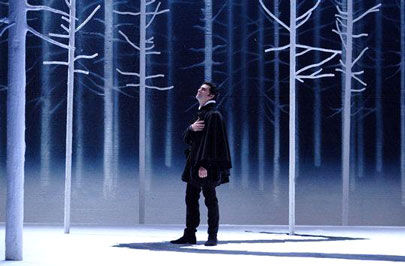
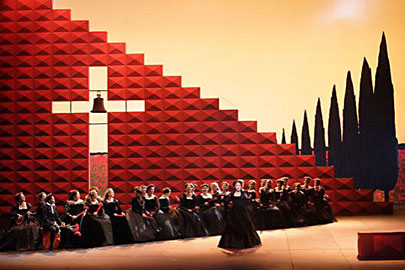
But for an opera which has such potential for beauty and grandeur, Bob Crowley‘s designs are curiously lacking in inspiration. Act I shows us white plastic trees, two white tree stumps and a piece of white sheeting on the ground to represent snow; the cloister of San Yuste is represented by a pitifully basic tomb with ‘Carlos’ written on the side; the wall in Act II, Part 2 looks as if it’s been made out of giant Lego bricks with a cross-shaped hole in the middle; and the King’s Study scene has rarely been so emptily or dully staged in my experience. All the symbolism has been too broadly painted – religion and the loneliness of power are represented but not explored to their full potential – and on the other hand, the loud shouting and jeering of the chorus during the condemnation of the heretics in Act III is wildly excessive …
On the other hand, Rolando Villazón wins enthusiastic praise for the “elegance of line” and “classical nuance” of his singing, which the reviewer found “deeply moving.” Not surprisingly, though, “Villazón was occasionally a little too neurotic in terms of acting.”
The Met Futures page is currently under construction, so La Cieca can’t check this, but it seems that Villazón’s Carlos is one element of this production that will not make the journey to New York. Instead, we get the plastic trees and the Lego cloister.
OMG: La Cieca of course stand corrected re: Millo and Verdi, though we shall have to agree to disagree regarding la Stella. Because La Cieca was (tacitly) considering sopranos contemporaneous with Scotto (i.e., circa 1980) Millo’s name didn’t occur to her at that moment. Millo would not be an example of what I called earlier a “blunt-instrument” voice. Though she has never achieved the level of detailed finesse Scotto brought to her best work, Millo did (and does) I think have a profound intuitive understanding of Italianate style, really the finest of her generation as a combination of voice and artist.
La Cieca, your rebuke is justified. It’s bad form to quote primary sources without citing them properly. It’s unfair to the reader too.
Your analysis of Scotto’s later career is formidable, and I’m sure you’re right. I thought I made it clear that I admired her stylish singing–her legato is indeed fine–and her Italian enunciation. But … for many of us it just didn’t make up for her lack of voice, particularly in a house the size of the Met.
And “given the choice between legato and a fat high C,” I admit I would find it hard to decide.
As I watched the clip a second time, I noticed a striking resemblance between Scotto and Vera Galupe-Borszkh. Rather than disagreeing over Scotto’s voice and career, perhaps one should explore this strange phenomenon.
I noticed a striking resemblance between Scotto and Vera Galupe-Borszkh.
As Madame once said a propos of la Scotto, “Without her, I would not exist.”
As far as I am aware there has only been 1 performance of DC at CG so far, the 1st night being last Sat 6th June and the second wed 11th June so how can Villazon have been booed at both performances I was at the 1st and I heard none. His voice is not miniscule you know if you really want to write on here get your facts right! Mabe you should indulge a little less in your Lasagne it seems to be affecting both your memory and judgement!
The importance and significance of La Resnik CANNOT be
exaggerated!
Regarding singers quoting “that was the highlight of my career”…I find that statement is always entirely conditional upon who they standing next to- or being interviewed by, at that time.
Paddypig rightly quotes Snr’s Domingo and Pavarotti talking about working with la Scotto as being their “career highlight” – only as recently as last weekend, I saw a documentary with the same two gentlemen saying individually that working on Lucia with Dame Joan was the apex. On another occasion I have heard Snr Pav something else was the most significant etc….
I don’t for a moment think they are being insincere- just like the rest of us, they find it equally difficult to sort out one wonderful experience from another….
so while I’m here and speaking of that – I must throw in my two-pence worth- I love Antionetta Stella whether she was an ideal Verdi exponent or not, love Scotto even though some notes were a bit shrill- love Millo cos she’s got something special and adored la Resnik cos she has always been great even when the pictures got small!
I just don’t know who these people are who come on here and post arrant nonsense whether its about serialism or whether a work is atonal and sheer stupidity about telling the difference, or about singers who if they heard them either did so when they were well past their primes, or when they the listener didn’t know what they were hearing.
Wozzeck has one twelve note scene (the Doctor and Wozzeck) otherwise as is also true in Lulu (a work that uses a twelve note technique largely of Berg’s own devising) and in the great Violin concerto (more or less twelve note) Berg constantly plays with key centers. The ear hears long stretches of all these works as complex but ‘tonal’, and there are gorgeous tunes in all of them which anyone with a musical sense can pick out — and not after dozens of hearings either. Some American ‘serialist’ composers became rather doctrinaire at least in some pieces (Carter and Babbitt might be described that way) but not in others — Carter’s Double Concerto for piano, harpsichord and 2 chamber orchestras, Syringa and the Concerto for Orchestra are all gorgeous pieces, while anyone who likes music should find Robert Taub’s CD of Babbitt piano music. Babbitt invented total serialism imitated (some say) by Boulez (I think he says not), but he too wrote much gorgeous music, of which Pli selon Pli is overwhelming. The scene between Elektra and Klytemnestra is atonal and I think the best scene in Strauss, there are also atonal stretches in Salome, Franz Schreker’s operas have long atonal stretches — and you can certainly ‘tell the difference’ between ‘atonal’ and ‘serial’ music, but both can be very beautiful as Sessions’ Montezuma proves (serial but soaring and gorgeous).
As to the silliness about Stella you can’t have heard her live in good shape — this was certainly a Verdi spinto voice. It was big, and she was easy throughout the range of all the heavy roles. She had a massive chest, a resonant, arresting middle, and a stunning top. She had stamina too. After about 1965 she went into a decline to a degree (let’s not get carried away), that meant she could scream the top, and her registers separated but she could deliver with force, natural color and thrust into the 1970′s. She was not a refined or subtle singer but she had tons of personality and temperament, and an abandon on a large scale nobody after her in the Italian roles had (Marton had it but wasn’t Italianate, Norman had it but avoided the Italian roles in her operatic prime). Scotto was certainly the whole package for at least a decade — her voice had grown by her return to the Met in Vespri and she sang with force and impact. It wasn’t the size of Stella’s voice but it wasn’t small, I remember how much impact and color her singing had in about 8 Don Carlos, and that Vespri was incredible and those big scaled Butterfly’s sailing out into a huge house with the orchestra not holding back were thrilling in the late 70′s. And both goes at the Trittico, 70′s and then 80′s showed she could open up thrillingly for the last ten minutes of Suor Angelica, voice killing writing. The first Norma was a bad night for her, but two later ones were strongly sung and effective; she didn’t have what Ponselle or Arangi-Lombardi would have had, but she did the role on a good scale with elegance, force and emotion.
As to her manipulation, that was silly. I remember the Alice Tully concert which maybe 50 people came to and I think that might have been it. Levine liked her but everyone who dealt with her found her hard working, willing to help a colleague out and so expressive it was easy to be expressive with her. I’m sure anybody with a big career of any length has met more than one remarkable colleague — but everyone I know who sang with her really respected Scotto, and felt respected in turn. Some were surprised for she did get a reputation for being bitchy — she knew her worth in other words and is a frank lady — but aside from a sunt or two, neither of them good colleagues by any stretch, I never heard anyone seriously put her down with details.
La Cieca, I agree with you. I don’t think Scotto anything that other singers haven’t also done, which is decide to take chances at a point in their careers when they could afford to. Sills did it, too, when she undertook the Donizetti Queens. And why not. Sills had already been singing for 30 years by the time she did them (don’t forget she sang on Major Bowes in the 30s as a child and had been touring since she was in her teens). I’m sure that by the time Scotto tried the “heavier” roles in her repertoire, she’d been singing for quite some time, too. What bothers me more are the younger singers just making a name for themselves who get pushed into, or choose to sing, roles that are too heavy for them in houses that are too big. Just because a tenor might have a baritonal sound similar to Domingo doesn’t mean he’s Domingo. (that’s just an example. I’m sure we all have singers we’ve heard that are singing roles that are completely wrong for them)
Old Acorns – Villazon was certainly booed on the opening night of Don Carlo – and his voice sounded stretched and small – almost to the point of inaudibility when he moved upstage.
Ninfa, I dont know where you were sitting but from the back of the stalls circle he was perfectly audible, and the acoustic there is not the best.