La Cieca has just exited the season preview for the Met’s 08-09 season (no, she was not thrown out, she left of her own volition) and here’s what’s up.
The most dramatic moment was in the Q&A at the end when a critic (at this moment unidentified) critic John Simon began by praising Peter Gelb, then said, “One mark of genius is the ability to learn from one’s mistakes. Do you plan on learning from two of your most egregious mistakes, namely Mary Zimmerman and John Doyle?”
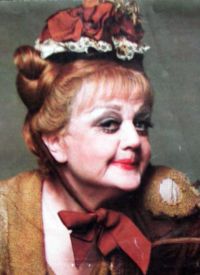 A gasp rang through the hall, and Sally Billinghurst (I swear) exclaimed, “Well, I never!”
Gelb went to bat for Zimmerman (who after all was seated only a few feet from the podium) saying that after next season’s Sonnambula he hopes she will return for more productions here. He remained silent about Doyle. PG also addressed the recent NYT interview dishing la Zimmerman, defending her technique of asking the singers what the words mean. It’s not because she doesn’t know, he says, it’s a way of making them think about the words.
To begin (or continue, anyway) at the beginning: last year the Met’s introductory press conference was preset with a collection of set models for new productions. This year we’re seeing large posters of what presumably will be the season’s stars: Natalie Dessay, Salvatore Licitra, Renee Fleming, what looks like Marcello Giordani in a tailcoat riding a black horse, Angela Gheorghiu in her Rondine frock, and Gerard Gerald Finley in Dr. Atomic. (These photos also represent the six new productions, which are precisely as described by the prescient MetManiac.)
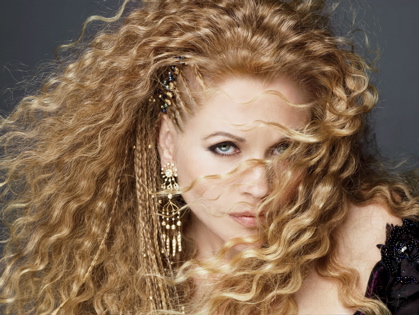
The Beautiful Face (in this case, indeed, the photography is wonderfully glamorous) also graces the outside of the press kit in a sultry Thais pose. This is only fair, since the season opens on September 22 with an all-Fleming-all-the-time gala: one act each of Capriccio, Traviata and Manon. In a special pre-season tribute to Luciano Pavarotti, James Levine will lead a free performance of the Verdi Requiem (September 18) with soloists including Barbara Frittoli, Olga Borodina, Giordani and James Morris.
An intriguing gala (or, anyway, an intriguing idea for a gala) will mark the company’s 125th anniversary as well as Placido Domingo’s 40th: “fully-staged scenes that recreate historic productions.â€
A “new team†will be responsible for Dr. Atomic (debut of John Adams at Met). This will be an all new production, coproduction with English National Opera. Other “Gelb†show is Berlioz Damnation. As we know by now, Zimmerman will direct La sonnambula (“after all,” La Cieca should say). Il trovatore “has a notorious record at the Met,†says Gelb, obviously alluding to the great Taco Chip fiasco of the year 2000. This (one hopes) more audience-friendly staging will mark David McVicar’s Met debut as director.
Six new productions next season (instead of seven) will “make room for the revival of Otto Schenk Ring cycle.†Otto himself will return to oversee this revival. The policy going forward will be (when possible) to have the original directors of new productions return in later season to prepare revivals. In 09-10 there will be eight new productions.
As part of the Domingo 40th anniversary, he will conduct Adriana Lecouvreur with Marcelo Alvarez (as Maurizio, silly.) Daniel Barenboim debuts; Seiji Ozawa returns after 16 years. Valery Gergiev ended his stint as principal guest conductor least year but will return in future seasons. There are no immediate plans to appoint a new principal guest conductor.
Stephanie Blythe will sing Orfeo!
Media plans continue to expand. HD season begins in October. Gelb announced a planned expansion of the HD in schools program but offered no firm details at this time.
In 2010-11, Met premiere of Nixon in China (directed by Peter Sellars). New production of Ades’ Tempest in 2012-13. The Osvaldo Golijov commision in 2011-2012 will probably be called Daedalus and will definitely have a libretto by Anthony Minghella. The story will have something to do with the Greek myth and some other stuff as well. (La Cieca guesses that this piece is at the moment still very much a work in progress.)
More Gelb: no increase in basic ticket prices for this season; no increase planned until following season at the earliest.
Penny Woolcock makes her opera directing debut with Doctor Atomic. Her talk was more about the work than her approach — the production stills look fairly conservative as opposed to the Sellars method.
Robert LePage “invents new ways of telling stories.†The Damnation production was Gelb’s baby at the Saito Kainen festival back in the 90s. The Met bought the production from the Paris Opera.
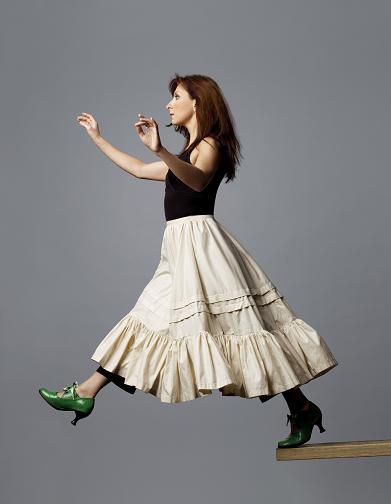
Mary Zimmerman “will continue her exploration of opera production†with La sonnambula. This production will be “remarkably different†from the Lucia, Gelb says.
Zimmerman reports that “Natalie said, ‘Oh, no! You cannot set it in a Swiss village!’†So Zimmerman will set the opera in a rehearsal room for Sonnambula to start with, then it grows from there. “In the rehearsal room we are trying to make the unreal real; in that liminal state rehearsal is like sleepwalking…. The audience is not treated to the decoration, but they are participants in creating.†Zimmerman promises a big scene change “to Switzerland†for the finale.
Levine (in between rehearsals of Tristan, god bless him) spoke about how he thought Gelb was working to enhance the dramatic and technical qualities of the house in a parallel fashion to the way he built up the Met orchestra over the past couple of decades. Another positive note he struck was that he felt that under the current regime he (Levine) was being saddled with fewer administrative duties, leaving him more energy to devote to music-making.
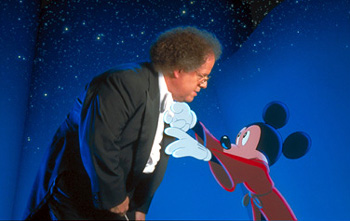
La Cieca will add that as she was tap tap tapping away at her laptop, she overheard the maestro chatting briefly with a member of the media (the critic for one of the metropolitan dailies, as a matter of fact.) When complimented on his noticeably slimmer appearance, Levine acknowledged that he has lost around 50 pounds since his shoulder surgery. The newspaper person also recalled an incident at a party when the maestro sang extended excerpts from the score of Fiddler on the Roof!
Levine modestly replied that he thought he had a good ear and so whatever interpretation he might have brought to the Bock/Harnick tuner was the result of hearing Zero Mostel in the role of Tevye. (This last part is purely gossip, but La Cieca thinks it’s kind of charming to think of Levine belting out “If I Were a Rich Man” after a cocktail or two.)
Full details on the season (though, alas, nothing at all about Jimmy’s show tunes) at metopera.org.