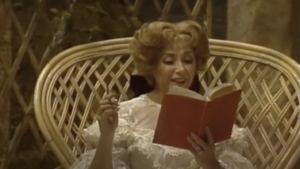
Lyon’s share
La Cieca hears the good news that Ruth Ann Swenson has recovered well enough from her cancer treatment to jump into a couple of performances of Maria Stuarda at the Opéra de Lyon this past week.
Copyright © 2012 parterre box - All Rights Reserved
Powered by WordPress · Parterror Theme by Nick Scholl for DIS Magazine
tKLogan wrote: “[Sills' Stuarda] is full of distortions and high notes that don’t exist inserted for pure vocal display. That is true for everything Sills did in bel canto by the way.”
TK: If you can listen to Sills in bel canto and come away thinking that the decorative additions and high notes are “purely for display” than this says much about your ears and the ways you listen to and process music. I’m not saying it’s a limitation, but it sure goes a LONG way toward explaining why you might have been able to find Swenson so satisfying.
Gualtier Malde
You make a refererence to RAS age, as being 47 years old. Many sopranos in their 40s, 50 and even 60s can be in top vocal form, e.g Magda Olivero, who, at the age of 69, sang Tosca with Pavarotti in the 1979 Met’s tour. I heard her in Cleveland and her performance was memorable. Angela Brown is 43 and I saw her at the Met’s opening night of Aida. Her voice soared and she broke the house down; the best Aida I’ve seen in years. Ruth is still in top vocal form and her illness, unfortunately, maybe an issue but not her age. To patronize good opera singers only for their youth is not artistically honest.
note to tkLogan re:Tomassini –
it’s not just that Tony is famous for his clueless opera “reviews” (they basically come down to raving about sopranos he once thought were pretty). What is truly maddening is his tendency, especially in the case of RAS time and again and now Dessay, to offer technical comments about their supposedly wonderful techniques, including frequent reference to their excellent “support from the diaphram” – as if a) he has an idea what that is, and b) that’s not just a useless catchall phrase used by people who don’t know sh*t about vocal technique.
It’s especially rich he uses it with these 2 girls, as RAS has always had a faulty technique, over darkening her middle and singing OFF the breath, which causes her upper extension disconnect, while Dessay how has to result to all types of manipulation and manufacturing in order to get her voice to work in its various registers (I still love her for the drama and commitment, btw, but that doesn’t mean she’s singing healthily).
Oh, and like Tony, if you don’t understand bel canto practice enough to know that interpolations are idomatic, standard, and correct, then you shouldn’t be commenting on them.
Constantine, I mentioned Ruth Ann’s age because there had been an inquiry as to Miricioiu’s age and I mistakenly thought it was about Swenson. No Swenson is not old for an opera singer though 47 is one thing for a lyric coloratura soprano who formerly specialized in “ina” roles (as Battle found out) and another for a Wagnerian soprano like Christine Brewer who is in her early fifties and at the peak of her career. Part of the reason Gelb was sidelining Hong and Swenson was not only perceived overexposure but their age.
This is patently unfair because Placido Domingo who may be over 70 is playing the young and tormented Oreste in Gluck’s “Iphigenie en Tauride” at the Met this season. Really it ought to be a young man or someone who reads young onstage which Domingo, for all his amazing vocal longevity and musical curiosity, can’t do right now.
If you read my entire post, you will see that it is very supportive of Swenson and positive about her. I also was at the Maria Stuarda and enjoyed her performance from a purely vocal standpoint despite a few blemishes (she lacked Caballé’s and Sutherland’s breath control in the final aria, for example). The part can be attacked in a restrained, lyrical manner or done as a firebrand kunstdiva turn. It is the most lyrical of the Three Queens. In general I still preferred Sills, Caballé and Gencer but in these times of lowered standards, Swenson did just fine for a concert.
Given the fact that she now has some stage experience in the role and done it a few times, I am sure that she has found more in it. I am pretty sure the OONY performance was her first ever.
Brewer must be in here very, very early fifties. Or maybe only 50.
Dear Balabanov 11,
Regardless of terms used, there are certain basic physiological facts about singing that can be enhanced or manipulated up to a point, but rarely altered.
We’re capable of speaking or singing only while exhaling. The deeper the inhaling, the lower the diphragm moves, and the higher volume of air is stored in the lungs. While exhaling, air passing through the vocal cords will make them vibrate and will initiate either a speaking or a singing sound depending on brain input. While exhaling, the diaphragm is moving upwards and can contol the volume and the force of air moving out of the lungs and passing through the vocal cords to make them vibrate. By training, the diaphragm can enhance the length of singing in between breaths, thus helping a singer to sustain a vocal line longer. It has nothing to do with the pitch or color of voice.
Every oprera singer is born with a certain pitch that may determine his or her vocal range, unless vocal training falsifies one’s vocal anatomy (countertenors).
The pitch and vocal range depend on the length and thickness of the vocal cords. Sopranos have shorter and thinner vocal cords in comparison to the longer and thicker vocal cords of mezzo-sopranos and contraltos. The same analogy applies to tenors, baritones and bassos. The differential in length may be minimal but its influence on pitch and vocal range is precipitous. The vocal cords are the most miraculous musical imstrument. When a soprano hits a high C the vocal cords can vibrate 1000 times per second!
When the singing sound reaches the head, the skull, muscles, tongue, ovula, palate, lips, nose and sinuses act as a resonator and will determine the color and timbre of the singing sound. The distinct timbre and color of a Stadivarius sound comes out of the resonator- the body of the violin-and not the strings. And the player with his brain and dexterity can enhance the built-in capabilities of the resonator.
Once I was attacked when I made a comment that mezzo-sopranos were better suited to sing castrato roles than counetretenors whose voice is not natural but constructed. This is where maipulation of vocal range and pitch come in with smart training.
Castration in chilhood arrests the the growth of the length of the vocal cords and the pitch of the voice will remain at the boy-soprano range. With the eventual growth of the rest of the body the voice will become stronger but the soprano pitch will remain unchanged. The vocal cords of a castrato should look like the vocal cords of a mezzo-soprano or even a soprano, whereas the vocal cords of a countertenor should look like the vocal cords of a fully grown man, unless testosterone deficiency was diagnosed and not treated during pubescence.
We can argue about diaphragm, chest voice, head voice, natural or not not-natural sound, timbre, color, etc., but every opera singer has been given a certain gift that can be enhanced with proper vocal training, provided that certain anatomical and physiological givens are undeestood and taken into consideration.
Now you’ve all got me curious about what Anonymous said….
Missed Ruth Ann’s Maria Stuarda; did hear Caballe, Sutherland and Sills in the part, also a couple of dames in Europe. Caballe was the best by miles; I never liked Sills’s voice after about 1971. I missed Donald Gramm’s Don Pasquale because she had been so godawful as Thais and Lucrezia B that I just couldn’t bring myself to endure her Norina. I’ll always hold that against her. (Anybody know who’s singing Lucrezia in D.C. next season?)
Ruth Ann certainly isn’t an actress, and her Elvira and Rosina made me wince. Or, rather, shrug. But in roles of “sweet” and shallow personality, Ines, Amina, Adina, she was radiant. I’m told her Gilda and Marguerite were also exquisite — and I believe it. (Though a feisty Gilda, like Netrebko’s, can be thrilling.)
I wouldn’t want to hear RAS as Violetta — if that’s not a role that requires personality, what is? It’s up there with Carmen and Norma. So I wasn’t sure about Agrippina, which is a termagant part. Miricioiou sounded over the hill and out to pasture in Vespri at the Met; I hardly think it’s the time of life for her to take up Handel. I’ll let her try to prove me wrong, but in this golden age of Handel revival, it seems a pity they couldn’t find someone a bit more … echt.
If that Isolde from SF on the radio Saturday was Brewer when “over the hill,” I’m hanging on right through the flood plain. Best Wagner soprano-ism I’ve heard since Waltraud Meier was a girl, or anyway since Mattila’s Elsa.
- Hans Lick
Domingo hasn’t hit seventy yet.
I’ve never knowingly heard Swenson- she’s neither recorded much nor done much over here- but taking her core rep and her age into account, I can’t see much reason why the three Queens shouldn’t be within her powers, unless she’s been singing parts she shouldn’t have up to now.
I can’t resist opining. When I read Mr. Papas I think of many who should have been castrated as children and some who should have been killed with cruelty and have a second of calm.
There is nothing to say about RAS — she was a very decent lyric coloratura who did some things well — I actually saw three Juliette’s that were lovely, and she wasn’t as bad as many as Gilda, Marguerite or Cleopatra in San Fran. I’d be happy if she retained her skills and stamina but I wouldn’t be standing in line to see her, and she was a lousy Elvira at the Met, though not as bad as the Con d’or Russe.
Miricioiou is an invention of the English Ear. I heard or rather saw her Met debut and the only thing that kept her less bad than Sass is that it was Mimi (when Ricky Leech was good) and not Tosca. I thought the Vespri unspeakable, Niska was better!!!!
Hans Lick is right about Sills, for me the end was Thais, the worst thing I have ever seen a famous singer do and who could bear the thought of her Norina in Don Pasquale? So many people worshiped her and maybe she was great with just a bad ending but I liked Pat Brooks so much more as Lucia and Manon and Violetta, and Arlene Saunders as Louise — though to be totally fair there were feats Sills could accomplish in that brief time when she was both famous and in good condition that few could match (yet there was never in my ear a steady beautiful core to her tone, as there was with say, Caballe). The Cleopatra though laughably ornamented and in the context of a horribly barbarous musical butchery (including an unreal ‘orchestration’)was one of those great events one can’t gainsay.
Tommasini is the best musician ever to review for the Times, bar none. He is a superb pianist and a score reader of dazzling facility. His understanding of mid and late 20th century music is profound, I have met his like only in highly specialized people in Universities or in the wilderness of their own minds (the late very, very, very great Dika Newlin).
Sadly he doesn’t know a thing about opera or voices and has terrible taste about productions, and frankly is at a loss at prima ottocento rep and indeed much written in the 19th century, some of his writing on Wagner is dumber than even AC Douglas. There are worse people and far lesser musicians who make a joke of the Times — Holland and when he was there Henahan (the stupidest review of a masterwork ever, his pan of Sessions’ great Montezuma). But TT is a sorry chief critic for the general rep.
I don’t get loving Sills Stuarda; there really was much better at the time, which as always is not to say she wasn’t very smart and intermittently effective. RAS however was not competitive with Sills Chez Quaalude, I thought her nudging her way through the range and her various registers distracting.
ANONYMOUS….you keep it up and your twat will be going home in a wheelchair. And if you are a “troll queen”, then whatever you have looks like a twat and IT will go home in a wheelchair