
Headshot of La Cieca

Cher Public

  • oedipe: You are right, I almost forgot! Though -as she is the one and only and way past sale by date, whereas... 5:13 AM
  • armerjacquino: Apart from the fact that the singer he originally cast is French. 4:51 AM
  • oedipe: That’s why she is moving on to French roles, which ANYBODY can sing. Of course, it would never occur... 4:23 AM
  • Feldmarschallin: What a surprise this morning when I was listening to Bayern 4 Klassik at 7 and they bring a... 2:39 AM
  • antikitschychick: This was a smart move…if anything a definitive attempt to distance himself from the... 12:38 AM
  • antikitschychick: ITA. Very well-put. As Cieca incisively noted, debacles/decisions like these are not just about... 12:20 AM
  • antikitschychick: Manou, your wit is boundless!! This has truly made me LMAO!! 11:34 PM
  • Bosah: Very glad to hear that. Thanks for the information. 11:34 PM

Take that, Eurotrash!

The doyen of operatic stage direction has done it again! (Or, to be strictly accurate, he has done it for about the twentieth time, but who’s counting?) Thrill to the brilliantly innovative new production of La traviata Franco Zeffirelli just unveiled at the Rome Opera!
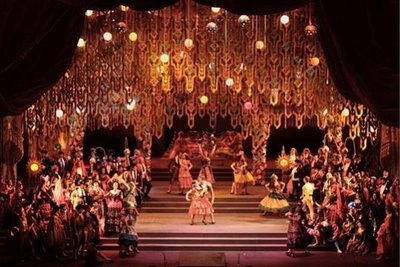

Oh, if only we could have a production of Traviata just like this here in New York! Or, even better, if only we could have two productions just like this!
39 comments

  • iltenoredigrazia says:

    Clarification: I’m not against lavish productions in general. The Zeffirelli Turandot, Boheme, Cav/Pag, Falstaff (not actually grandiose), and in particular his old Otello were great. It’s in Traviata specifically where I find them to go against the story and the music. Nor am I suggesting that a production should necessarily be historically accurate. But some operas demand at least a reference to a certain period, locality, and social conditions. Boheme or Manon not in Paris? Aida not in Egypt? Tosca not in Rome? Not a church for the first act of Tosca? Floria in rags? Jewels for Mimi? No Florence in Gianni Schicchi?

    Now, Traviata doesn’t have to be in Paris or in mid-XVIII Century but it must reflect that Violetta is down to her last 20 scudi for the last act. Nothing in the set or production should detract from the excruciatingly painful exchange in the second act between Violetta and Germont pere. It could be done in a dark stage with not sets. All the drama and more is on the characters singing and reactions. Similarly, the last act should convey the utter pain and misery to which Violetta has fallen. It should offer a contrast with her lifestyle in the first act. It’s got to be sad. Verdi’s music wants you to cry.

    There’s a place and time for everything. Lavishness in the second and last scenes of Traviata is wrong, wrong, wrong.

  • Bel Canto 2 says:

    Zef = at least one scene with a cast of thousands and usually some kind of animal worked into the staging (ie. Carmen)

    I liked his Tosca reflecting the actual places where the opera took place.

    And though Zef didn’t do the set for the old Barber of Seville, I liked that much better than the new one.

    People seemed to be confused by so many doors. And yes, for me that is a minimalist set.

  • justanother says:

    ITDCS, I just want a quick clarification as to your justification for Violetta keeping her house because “she was VERY rich.”
    Is there a translation of the following I am missing, or an interpretation I have completely misunderstood (especially the last two line):
    V: “Quale somma v’ha in quello stipo?”
    A: “venti luigi”
    V: “Dieci ne reca a’ poveri tu stessa”
    A: “Poco rimanvi allora”
    V: “Oh mi saran bastanti”

    Now you could argue it says “quello stipo” and maybe there are millions stashed away in a bank in Switzerland, but then why should Annina worry about how much there is left.

    You state that “we know that most librettos are rather weak.” I don’t know, perhaps what we really have are weak uderstandings of librettos, and a lack of desire to ensure Opera remains Theatre. No matter what anyone says, whether it is an argument for “prima la musica” or not, Opera IS Theatre. Words cannot be discounted.

    I don’t think the opposite of “stages crippled with overbearing sets” is “Eurotrash.” Is Carsen’s production of Onegin Eurotrash? I would venture that it is an honest production where great attention has been given to music and text.

    Zef’s Second Act of La Boheme for example is in the wrost of taste, in my opinion. It may grandiose, but after seeing it five times, I still can;t figure out where Marcello is for the first five minutes. That, to me, is a problem.

  • La Cieca says:

    justanother:

    A point made in the novel La Dame aux camelias and I think at least suggested in the play based on it is this: Marguerite has a lot of possessions and enormous debt. Her creditors get a court order freezing her assets so that they can be sold and the proceeds distributed to pay off some percentage of the debts owed. Bailiffs are posted in Marguerite’s flat to assure that she does not try to raise money by selling any of the seized goods.

    The irony is very effective: essentially she dies in poverty surrounded by luxury.

    IDTCS is incorrect. Marguerite/Violetta is never actually wealthy; rather, she lives (or lived) a luxurious lifestyle while running up a fortune in debt.

    The party at Flora’s is the only slightly plausible excuse for spectacle in an otherwise intimate drama. And yet, even Flora’s soiree loses a lot in dramatic point if it’s too grand.

  • Constantine A. Papas says:

    Eurotrash is an understatement! This is Euroglitter garage sale Stanford & Son junk!
    Talking about intimacy, emotions, and inpetuous young lovers, Decker has set the standards with the 2005 Salzburg production of La Traviata. He succeeded because of Netrebko and Villazon who, with their glorious singing and acting, captured the depths of the souls of the protagonists to perfection. No distracring dusty decor and stiltedness, but perpetual motion of loving, teasing, laughing and living to a complete abandon, and exposing the darkness of human dispair with starkness and the realism of nothingness, relying only on the hope of divine provdence. The intellectual and emotional sybbolism and metaphors in the production are mind-boggling and convey the real spirit and what Verdi had in mind: hardcore pleasure as if there is no tomorrow, passion, and the transforming and redeaming power of love, even in death. As for me, this is La Traviata I want to live and die with. I hope, when this production comes to the Met, although I live in Texas, to find a ticket to see La Traviata of my lifetime. And I’ve seen many esteemed Violettas- dramatically and vocally- in the past forty years.

  • justanother says:

    La Cieca,
    doesn’t Zefirelli do just that in his movie version of Traviata – I seem to recall people (maybe during the overture, which is played out as if the whole story is re-lived in the dying Violetta’s mind I think) moving things around and taking furniture away.
    I must go re-read my Dumas also.

    I know it was quite controversial, but I did find Jonathan Miller’s idea for the Paris Production of putting Violetta in a public hospice quite intelligent (he is much maligned on this site, but sometimes what he does works). It underlined the horrible social decline of Violetta and her status as an outcast.

    There are stage directions for Act III. Those set directions, although they mention what furniture is needed and in what order in needs to be arranged, do not mention where the third act happens precisely. The First Act Mentions “Salotto in Casa di Violetta”, the Third fails to mention the word “house,” only limiting the action to “Camera da Letto di Violetta.” I find the omission quite conspicuous. In adapting a play to an opera, changes always happen. Surely Rigoletto is not quite strict in its adaptation of le Roi S’amuse.

    Although I do think what Zef did in the movie was quite effective, couldn’t we take Verdi’s setting of the third act – and the fact that he does not introduce any new characters (in the form of creditors or bailiffs) or inform us of the legal proceedings against Violetta – to a garrett? Especially as we have already been told that Violetta HAS sold all her posessions. (Annina returns from Paris saying she was sent there “Per alienar cavalli, cocchi e quanto ancor possiede,” suggesting strongly that the mission was accomplished in the interaction with Alfredo, stating they are STILL (“OR v’abbisogna… Mille luigi”) a thousand Louis short).

    I think Il tenore di grazia’s suggestion to use the Act I Boheme set is brilliant. Having Violetta die in a rented out Maid’s room on the top floor of a working class building – with Annina faithfully standing by is very convincing.

  • phineas57 says:

    What is that?

  • justanother says:

    Sorry. “That” referred to: “Marguerite has a lot of possessions and enormous debt. Her creditors get a court order freezing her assets so that they can be sold and the proceeds distributed to pay off some percentage of the debts owed. Bailiffs are posted in Marguerite’s flat to assure that she does not try to raise money by selling any of the seized goods.”

  • OPÉRA CHANTEUSE says:

    This production in Rome is grandiose done in the worst possible way: there is no harmony, nor proportion. Truly hideous. Mr. Zeffirelli should ought to follow the motto: “Beauty and proportion is an artist’s guiding principle.”
    Enough said.

  • Constantine A. Papas says:

    Oops!I meant ‘symbolism.’