

Headshot of La Cieca

Cher Public


blog advertising is good for you

Pass that peace pipe!

All right, class. Take a careful look at the costume sketch below. It’s for a major character in a standard repertory opera. (In other words, nobody is doing Natoma.) Look carefully at the sketch, and when you think you know who the character is, scroll down to find out the answer.
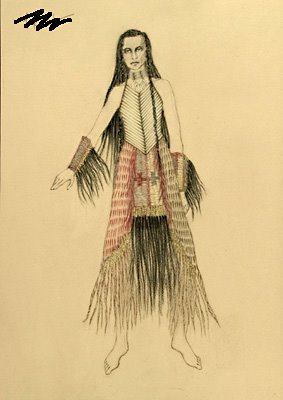

Think you know who this character is? All right then, scroll down the page….

keep scrolling….

scroll yet some more…

and once again…

The character depicted is . . . Erda in Der Ring des Nibelungen.

Yes, that right, the Der Ring des Nibelungen by Richard Wagner. It’s a new production of the tetralogy for Washington National Opera, directed by Francesca Zambello. According to a press release from the WNO, this is to be an “American Ring,” a concept explicated by Zambello thus: “the designers and I are using American history, mythology, iconography, and landscape to set the operas. We are creating a world in some ways familiar to our audience but also one that will feel very mythic as we look to our country’s rich imagery.”

Wotan (Robert Hale) is depicted in another of designer Michael Yeargan‘s sketches in a dapper frock coat, a la Horace Tabor. And so, you are surely asking yourself, how do the Niblelungs fit into this scheme. La Cieca is glad you asked.
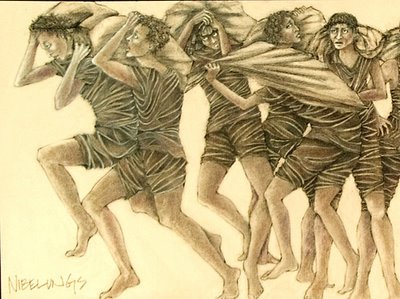
OH NO THEY DIDN’T! Das Rheingold opens in March, and we’ll see how this goes from there.
36 comments

  • A.C. Douglas says:

    As odd as it might sound coming from me, this Konzept … er, Concept might actually work. This one seems to be one of those rare Concepts that really can’t be prejudged out of hand. I mean, it’s not a prima facie idiot outrage such as, say, the Chéreau Ring. Have to see how the director / producer / et al. handle the thing, especially as it concerns its correspondence with the music.

    ACD

  • rysanekfreak says:

    I want to stage my own Ring update.

    The Ring set in Hollywood.

    The gold they are fighting over is the Oscar. Wotan is the head of Valhalla Studios. They all drive through the gates of the new studio in big limos at the end of “Rheingold.”

    The Rhine becomes a Beverly Hills swimming pool. The Rhinemaidens are bikini’d starlets tossing around a gold beachball. Alberich looks like Danny di Vito.

    Siegmund looks like James Dean.
    Sieglinde looks like a young Liz Taylor.
    Brunhilde looks like Bette Davis.
    Siegfried looks like a young Bogart.

    Well, you get the picture…

  • Il Tenore di Coloratura Superba says:

    rysanekfreak, you might really have something there!

    jfl, Wagner may not have been able to ‘tweak’ everything to be perfect, but his ideas and concepts of his own mucis-dramas were extremely carefully thought out. It was really amazing, for his time, how advanced his designs for his sets were as compared to other operas and theatrical pieces. Even the whole swan-boat in Lohengrin must have been an amazing site for audiences who would have attended the premiere. Granted, Wagner had a crazy king who was willing to spend every single one of his and his subjects money to fufill Wagner’s megaolmaniac appetite. But what I was stating earlier is that a really good and creative and hard working director can take Wagner’s pre-set ideas and information utilize them to make a truly interesting, physically and musically lively (yes, Der Ring doesn’t HAVE to be 20 hours of boredeom!) performance.

    As one who primarily advocates performing a piece of music as though the composer himself were present (which means ALOT of research and study and reading on the part of the performer to try and understand the performance practices of the time, the tastes of the composer and his audiences, the methods of his contemporary performers, and his compositional techniques – I’ve written about this at length several months ago in some entries in some wonderful discussions with other contributors). Seeing that Wagner, unlike so many composers before the 20th century, was his own librettist and director and set/costume designer, one really should approach producing one of his masterpieces with a complete respect of all facets of his genius and hardwork. Of course, we can’t change the notes on the page or the words attached to them, but even though we can alter the visual and physical elements of the works, I think it’s important for any director who plans to do Wagner to take the time and study what he has already given us for the purpose of finding inspiration, understanding, knowledge, and most of all, to put forth new, creative ideas in performances of his work that are always founded on respect for his mastery of his art.

    jfl, I am most certainly not attacking your views, I am very interested in your opinions and ideas – you seem to be a well-read and intelligent person.

    I also highly recommend to anyone who is a Wagnerite/Rossinian to read the famous conversation that took place between the two great men in 1860 in Paris. There is alot of incredible information there, especially how Wagner sells his concepts and art to the Ottocento master.

  • jfl says:

    “As one who primarily advocates performing a piece of music as though the composer himself were present (which means ALOT of research and study and reading on the part of the performer to try and understand the performance practices of the time, the tastes of the composer and his audiences, the methods of his contemporary performers, and his compositional techniques – I’ve written about this at length several months ago in some entries in some wonderful discussions with other contributors).”

    As such one… what? Just like you don’t mean to attack me, I don’t mean to, either. But this statement “As one who primarily advocates performing a piece of music as though the composer himself were present” is the end of the argument for me… or rather: The beginning of a NEW argument. Not one about operatic performance (because we disagree) but about morality.

    To put it bluntly (and in very distilled form): I think your attitude is a Sin. Not “sin” as in casual fashion sin… but as in a a moral misdemeanour. That’s a bit grave, perhaps… but what I mean by it is that it is counter to truth. It is a lie to ourselves to think it possible (both phsyically and psychologically) and a lie to the audience.

    Two identical statements separated by 100 years do not have the same meaning, do not contain the same information. To pretend otherwise is to make a grave blunder or is willfully deceiving. [Interestingly: Those who have above claims of Wagnerian 'authenticity' are often {I don't know about you, though} the first to demand that Bach and Handel be played like Klemperer, Scherchen, Solti, Beecham would have... rather than Suzuki, Junghanel or McCreesh. Only sometimes do they allow for Gardiner/Pinnick/Rilling.]

    “I think it’s important for any director who plans to do Wagner to take the time and study what he has already given us for the purpose of finding inspiration, understanding, knowledge, and most of all, to put forth new, creative ideas in performances of his work that are always founded on respect for his mastery of his art.”

    Here, of course, you are absolutely correct. And I don’t know anyone (not Chereau, not von Trier, not Wagner Grandsons, not Boulez) who did not just do that. That’s in part why their productions (well… none from Trier for now) or results were (though not necessarily) excellent. The continuous trashing of the Chereau-Ring (has ACD even seen the production? I doubt it, to be honest), to pick on one example, is utter nonsense. Chereau and Boulez both have forgotten more about Wagner than any of us will ever get to know… and not only is the Chereau Ring dramatically compelling like no opera I have ever seen, it is at the same time the one that is most strictly tied to the word in its action. To bad for those who don’t speak and read German beyond some impressive quotes on their blogs – but watching it with German subtitles and hearing it sung is baffling. Almost every move is rooted in the text – and just when you want to say: “Oh… puh-leeez, Mr. Chereau”, he actually just underlined in action that which the singers are singing. Anyway… I digress.

    I don’t ask you to believe me or change your mind… but this is the gist of how I feel about it and I shall be forthcoming with a longer article about it where I explain it in more detail. (Eventually, I guess, that will appear on ionarts.org).

    very best,

    jfl

  • A.C. Douglas says:

    JFL wrote: Chereau and Boulez both have forgotten more about Wagner than any of us will ever get to know… and not only is the Chereau Ring dramatically compelling like no opera I have ever seen, it is at the same time the one that is most strictly tied to the word in its action.

    A more ignorant set of statements is hard to imagine.

    Chereau, at the time he was given the commission for his idiot production, not only had NOT “forgotten more about Wagner than any of us will ever get to know,” but was, by his own admission, a total Wagner ignoramus (he actually bragged about it, the moron!). For most pertinent instance, Chereau imagined that the Ring was a single opera, and had not so much as a clue as to what it was about, and had to go scurrying about to find out, settling finally on G. B. Shaw’s witty but nonsensical and tendentious socialist tract, The Perfect Wagnerite, to use as his instruction manual for his production.

    And as to your appallingly ignorant statement that “the Chereau Ring … [is] the one that is most strictly tied to the word in its action,” that’s utter rubbish except in the most mechanical sense of the thing. The Chereau Ring‘s failure – its abject failure – to correspond in spirit, context, and sense with Wagner’s text and — more tellingly, and more egregiously — with Wagner’s music, is precisely what makes it the grotesque piece of Eurotrash it unquestionably is.

    ACD

  • A.C. Douglas says:

    Oops

    My,

    “…settling finally on G. B. Shaw’s witty but nonsensical and tendentious socialist tract, The Perfect Wagnerite…,”

    should have read,

    “…settling finally on G. B. Shaw’s witty but silly and tendentious socialist tract, The Perfect Wagnerite….”

    ACD

  • jfl says:

    …settling finally on G. B. Shaw’s witty but silly and tendentious socialist tract, The Perfect Wagnerite…

    it’s actually based on a ring production from leipzig (GDR) from the 70s which in turn was (loosely) based on shaw’s writing – but such minor details should not concern anyone who claims that Chereau’s (or any other European’s “Konzept…”) production is “prima facie absurd” or “prima facie idiot outrage”. nor should the fact that Chereau may have started out without knowledge about Wagner (unlike someone I know who was born with so much knowledge about Wagner and how he should be performed that it entitles her/him to ‘ex cathedra’ statements everywhere) but apparently gained more insight into its essence (even if he got the capitalism aspect completely upside down and backwards forwards): namely that it is, for all the gods and fish-women and midgets and whatnot, a human drama and if you cannot see at least that aspect done supremely well in Chereau – even if you disagree violently, “prima facie” even, with the general direction – then you are blind for all your supposed love for Wagner’s work.

  • A.C. Douglas says:

    That Chéreau “gained … insight,” as you put it, into the fact that the Ring is essentially “a human drama” despite “all the gods and fish-women and midgets and whatnot,” also as you put it, is hardly an accomplishment. Only a simpleton could be deaf and blind to that fact. But Chéreau — being the Eurotrash vandal that he is — instead of doing his utmost to realize on stage in the most effective and resonant manner possible that essence as Wagner envisioned it, chose instead to put his own impoverished vision by way of Shaw on display in its stead, thereby fixing in the most concrete manner possible this one particular — and particularly trivial — way of reading the drama, and by so doing robbed Wagner’s masterpiece of the very thing that’s central to its genius: its capacity to resonate simultaneously in multifarious ways, and at multiple layers of meaning, for an audience, the contemptible result being that in place of Wagner’s resonant cosmic drama, audiences had inflicted upon them a banal and squalid quasi-Marxist morality tale, as I’ve elsewhere characterized it, worthy only of a postmodern literary theorist.

    In short, Chéreau, like all his Eurotrash brethren, is nothing more or other than a self-important, self-involved, self-serving vandal; a parasite who feeds on the work of his betters and superiors, and in the process destroys utterly that on which he feeds.

    ACD

  • jfl says:

    hmmm. maybe. however, his work has ‘resonated with me simultaneously’ and ‘in multifarious ways’ – with me. so he must have succeeded in something, after all. and then of course he somehow tricked every single attendendee to his ring (during its last run, at least) into an 80 minute standing ovation and 100+ curtain calls, a bayreuth record. but I am sure there is a sheet of ‘talking points’ to counter that, too. (perhaps germans just don’t know how to do or even appreciate wagner.)

  • A.C. Douglas says:

    …and then of course he [Chéreau] somehow tricked every single attendendee to his ring (during its last [Bayreuth] run, at least) into an 80 minute standing ovation and 100+ curtain calls….

    By the time the Chéreau Ring reached the end of its four-year Bayreuth run (1980) it was considered by the “in” crowd of the snobbish Wagnerian world — especially the German Wagnerian world — to be hopelessly “counter-progressive” (whatever that was supposed to mean), even reactionary, to not greet the Chéreau Ring with an ovation. Do you imagine herd mentality and lemming behavior is confined to such as the proles in attendance at sporting events and political rallies?

    Think again.

    ACD