

Pass that peace pipe!
All right, class. Take a careful look at the costume sketch below. It’s for a major character in a standard repertory opera. (In other words, nobody is doing Natoma.) Look carefully at the sketch, and when you think you know who the character is, scroll down to find out the answer.
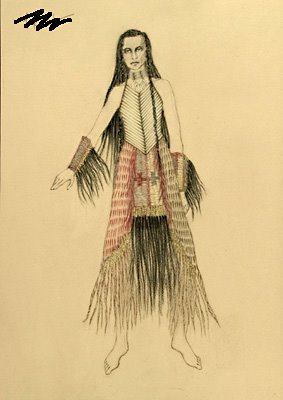
Think you know who this character is? All right then, scroll down the page….
keep scrolling….
scroll yet some more…
and once again…
The character depicted is . . . Erda in Der Ring des Nibelungen.
Yes, that right, the Der Ring des Nibelungen by Richard Wagner. It’s a new production of the tetralogy for Washington National Opera, directed by Francesca Zambello. According to a press release from the WNO, this is to be an “American Ring,” a concept explicated by Zambello thus: “the designers and I are using American history, mythology, iconography, and landscape to set the operas. We are creating a world in some ways familiar to our audience but also one that will feel very mythic as we look to our country’s rich imagery.”
Wotan (Robert Hale) is depicted in another of designer Michael Yeargan‘s sketches in a dapper frock coat, a la Horace Tabor. And so, you are surely asking yourself, how do the Niblelungs fit into this scheme. La Cieca is glad you asked.
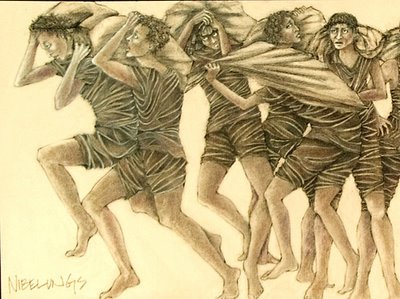
OH NO THEY DIDN’T! Das Rheingold opens in March, and we’ll see how this goes from there.
Well, this opera fan doesn’t care whether it’s Wagner or Monteverdi or whoever. The fact is that all opera companies in the country are begging for money. I suspect that hiring directors to come up with these so-called “updates” costs more than producing the same operas as intended by the composer. Even if in a simplified manner, as most likely required by some of Wagner’s works and others. Also “standard” versions last a lot longer. And those who go to the opera for its beautiful music are very unlikely to object to “traditional” stagings.
Thus, these “updated” productions means spending money that the companies don’t have in a manner that is not necessary.
Old fashioned painted canvases are plenty for me if the singing is good. And if the singing is not good, then I don’t care to be there regardless of what the production looks like.
But, as Dame Edna herself would say, just call me old fashioned.
this “updating” gives me the pip. Has anyone seen the Tosca done in the 30′s or the Boheme that uses light bulbs rather than candles. I have had it with this sort of stuff. It makes no sense within the concept of the operas and it ends up being boring infinitely
While I do love my good ol’ fashioned productions, there have been many updated productions that I have truly enjoyed and gained a new perspective on the piece itself.
In my opinion, operas can become reduced to “museum pieces” when one has traditional productions over and over again…which is why I guess we have updated productions. Opera and music are living, breathing things that are recreated each time they are performed…why not have a new view of them through updated productions?
I love opera for the singing, but I realize that opera is a complete art form, borrowing from music, theatre, dance, and design. As we change as a society, is it fair that we should want our music and theatre to be stuck and not change with us?
This is a heated debate in the opera world, and I guess will always be!
I think one has to differentiate between updates that work and updates that don’t work. So I’ll put what I said above into perspective: given the choice between the Götterdämmerung in which Luana de Vol chops up tomatoes in a badly wallpapered kitchen while Waltraute is trying to sing some sense into her and the Levine/Schenk Ring, I’ll take the Regietheater any time, thanks.
Updating can go terribly wrong, but palatable, conservative stageings that take no risks are, in my opinion, no more exciting than any old mainstream musical.
A young soprano who sings at the Met told me of a production of Carmen in Europe that she attended (in Germany I believe) where the director had decided to base his production on the BOOK rather than the LIBRETTO. In the book, Don Jose is the main character and Carmen herself has very little to do. In short (as her telling of the production was legnthy and I myself never saw it so I don’t want to make up details), the Carmen was set in an office where Carmen was a plain, frumpy secretary who made real photocopies on a real photocopier during the Habanera which she was made to sing upstage. Whenever possible, the director stuck her in the backgroud and did everything he could to make Don Jose the focal point of the opera. I guess they had Zuniga, the boss, murdered, and then all the ‘secretaries’ – i.e. gypsies – got into drug dealing and the ‘office’ became an anarchial state. Escamillio was a janitor who was dreaming of becoming a big executive during the Toreador song (This based on her description seemed to really work and would have been fun to watch).
At any rate, the girl who saw this agreed that overall there were some very interesting concepts and some informative new perspectives taken on the plot and character developments. But it was apparent that there was too much of a conflict of interest between the book and the libretto and between the opera’s setting and the director’s setting. Bizet wrote his opera about the female protagonist, not the male…even if the opposite was the case with the book…Bizet’s creation musically doesn’t allow such an idea to make sense. Shoving her into a grey pencil skirt with a white blouse in an ocean of grey and white doesn’t exactly make a lot of sense…then one stares and says “who’s singing!?” Also, the libretto and music of Carmen make such strong references to not only the action, but to the period and setting. I can’t imagine how the director set the last act outside the bullring…is the crowd part of the janitor’s imagination too?
At any rate, ‘updating’ an operatic scenario really should be something carefully thoughtout rather than arbitrarily thrown together for the mere purpose of doing something different as many of these ‘updates’ seem to be.
Not agains updates here if the company can afford them. I just don’t believe in going into debt to repaint the walls at home.
I saw a Dutchman in Paris a few years ago (Voigt was the Senta) in a single very modern/abstract setting that gave the work a rather new twist. It was wonderful. And I can’t think of the opera now in any other terms.
That Dutchman, however, went with the music, not against it. Carmen’s music is 19th Century French imitation Spanish. It calls for a vision that goes along.
I suspect that hiring directors to come up with these so-called “updates” costs more than producing the same operas as intended by the composer.
Actually, I suspect updated productions cost less than period productions. The main difference is in the costumes; you’re going to get built sets these days whether the production is period or contemporary. And creating elaborate period costumes which generally can’t be reused seems more expensive than using contemporary clothing, which genrally doesn’t require so many petticoats & furbelows & stuff. Especially if the contemporary clothing is much the same as was used in the last modern-dress production (all those damn black trenchcoats)!
***
Anyway, it’s that second drawing that bothers me. It’s not just the racial issues, it’s the economic ones; surely the Nibelungs are in manufacturing rather than agriculture?
But if Zambello is really going to use “American mythology” as a basis for her Ring, does that mean that Nothung becomes a Colt Peacemaker or a Winchester repeating rifle?
(My opinion as to updated productions in general is too complicated to go into here. But I can’t help wishing that Zambello had chosen to do a science-fiction-inspired Ring instead. I mean, we’ve had frockcoated Wotans as least as far back as the Chereau Ring…)
Where did you get those pictures? This is not the production concept in the Washington Opera’s promotional materials circulated to season subscribers, although very little is shown any way. I thought it was going to be more leather-and-Wagner, after the Walkure of a couple of seasons ago. In the promotional art for this Rheingold, you can see that Wotan is wearing a black leather jacket. Zambello’s Porgy and Bess here was very nice, and the update was practically transparent to me. This American Heritage Wagner, however, does not look good at first glance. Whatever, I’m looking forward to hearing conductor Heinz Fricke and the WNO orchestra.
Re: The second picture, the color on my monitor is skewed (probably not long before it gives up the ghost altogether).
Anyway, my first impression wasn’t that the Nibelungen were black but Chinese coolies. That would make some sense (don’t ask me quite how, but I think it could work) in a wild wild west version of the ring (the Amerindian Erda and description of Wotan as Horace Tabor may have thrown me off).
I assume the Valkyries will be Minnie-esque cowgirls and Sielginde will be a long suffering pioneer wife (Sigmund will be a loner cowboy a la Shane). The Gibichungen would be gold rush prospectors …
The only thing I hate more than failed ‘updated’ or ‘emphasized’ productions are those that didn’t even try. I am looking forward to Z.’s work (I like it sometimes – at other times it infuriates me) and pray that she comes up with NEW and BETTER ideas than she presented in a highly mediocre Walkuere two years ago. Last time the costume designer (who should have been taken down for the awful Walkuere-leather costumes that were neither novel nor good looking nor ‘sexy’ as claimed) betrayed her unfathomable basic ignorance about Wagner in some comments for the Washington Post (i.e. she seemingly thought the heros that the Walkuere’s picked up were still alive) that I nearly cried.
Still, I’d rather have Wotan move into a glorified Tepee than see an “authentic” production without acting and drama. (For all his ingenious inspirations, Wagner hardly had his product finished or tweaked to maximum impact at the time… nevermind the technical limitations.)
jfl