

Pass that peace pipe!
All right, class. Take a careful look at the costume sketch below. It’s for a major character in a standard repertory opera. (In other words, nobody is doing Natoma.) Look carefully at the sketch, and when you think you know who the character is, scroll down to find out the answer.
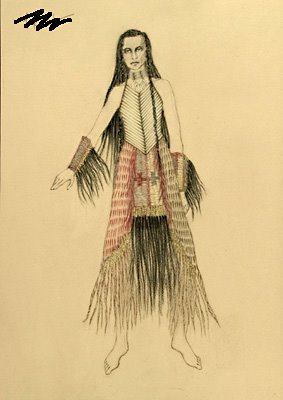
Think you know who this character is? All right then, scroll down the page….
keep scrolling….
scroll yet some more…
and once again…
The character depicted is . . . Erda in Der Ring des Nibelungen.
Yes, that right, the Der Ring des Nibelungen by Richard Wagner. It’s a new production of the tetralogy for Washington National Opera, directed by Francesca Zambello. According to a press release from the WNO, this is to be an “American Ring,” a concept explicated by Zambello thus: “the designers and I are using American history, mythology, iconography, and landscape to set the operas. We are creating a world in some ways familiar to our audience but also one that will feel very mythic as we look to our country’s rich imagery.”
Wotan (Robert Hale) is depicted in another of designer Michael Yeargan‘s sketches in a dapper frock coat, a la Horace Tabor. And so, you are surely asking yourself, how do the Niblelungs fit into this scheme. La Cieca is glad you asked.
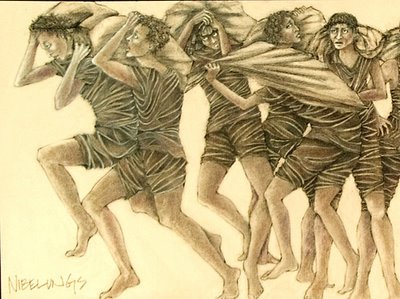
OH NO THEY DIDN’T! Das Rheingold opens in March, and we’ll see how this goes from there.
I think I prefer Anna Russell’s description of Erda…”A green torso…at least we think she’s a torso…that’s all anyone’s ever seen of her!”
God LOVE Anna Russell – if you’ve never heard her synopsis of Der Ring, I tell you it is sheer brilliance! And even though I myself don’t care for G&S, her lecture on “How to write your own G&S Operetta” is one of the funniest and most accurate things I have ever heard – I literally laughed my ass off – esp when she mentions the Alto! HAHAH
::wince::
If that goes on stage, I do not ever want to hear the word “Eurotrash” again.
I’m generally NOT a fan of “updating” operas to place them in times or settings different from those envisioned by the composer and/or librettist. I don’t even like it when producers change the lyrics in the “Mikado” to make it more modern — I’m sure you know the song of which I write. The most egregious example of this has to be the Martina Franca production of “Huguenots” a few years ago that reset the action between Nazis and Jews – repulsive on SO many levels! About the furthest I’d be willing to go with this concept (if at all) would move “Tosca” to Fascist Italy, although how one would work Cavaradossi’s enthusiasm for Napoleon’s triumph into the storyline is a stumper.
I give this the benefit of the doubt and actually this strikes me as pretty interesting. It’s nice to put unusual costumes on people, but it’s up to the director to make the concept make sense. This could be brilliant. Time will tell.
Discussion may ensue regarding changing the settings in operas by other composers…but with a composer like Wagner, one really is crossing what should be an uncrossable line. Wagner, and his philosophy of gesamtkunskwerke (I think I spelled that right) means that he himself went into so many details with his operas – in so far as to make costume and staging decisions. In a way, all of the theatrical particulars of his operas are an inherent part of the composition and should be considered as permanent as the notes and words are on the page. Obviously, there is always room for creativity with something like the Ring cycle and tho Wagner may well have had a coronary, I think he actually would have respected anyone who produced his operas in such a way that stayed in line with his greater vision, so although directors and producers may feel compelled to make ‘updated’ versions of his music…I personally think that is is best to keep Wagner’s opera’s as traditional as possible. That is the test of a really good director…one who can take the traditional and find ways to freshen it and liven the production to put his/her own personal thumbprint on it without interfering with Wagner’s vision or the necessary storyline.
I once saw a “Zauberflote” that was set in the American Southwest in the 1700s. Everyone was an Indian in gorgeous “Santa Fe outfits” except for Monostatos, who was a captured Conquistador.
The concept did not work. Because the Indians believed in FOUR as the magic number versus THREE…we got four ladies, four little boys. The extra ones didn’t sing. They just mouthed along. (or so the program notes told us)
And the singers had to do word-picture gestures while they sang. Poor Beverly Hoch as The Queen of the Night literally had to dance and twirl and hop around and “sign” as the tossed off those high notes. “Sign more than you sing?”
It was a pretty production to look at, but it really didn’t work.
Of course, it was quite memorable. I’ve seen quite a few “Zauberflote”s in my life, but this is the one I remember in vivid detail simply because it was so different. (not necessarily GOOD, just different)
So this “Ring” will be praised for its fabulous costumes and people will not write much about the singing.
You think that’s bad, wait until it moves to a real A house, the one that is co-producing it with them.
I can’t wait to see the SF Opera Board’s reaction to this Ring when they haven’t had one in over twenty years.
In the current Royal Opera Production Erda is got up like Queen Victoria – each country to its own cultural icons!
Wotan leaps onto her onto her at the very end of Rheingold to get on with the business of siring those 9 daughters. I think Jane Henschel is roubust enough to withstand the impact of Bryn Terfel.
What should an earth goddess wear in the 2001st century?
Twenty years ago Francesca Zambello and Stephen Wadsworth were Artistic Directors of the Skylight Comic Opera in Milwaukee. Who would have thought that they would someday each have Ring cycles on either end of the country? “Cesca” has always been a force to be reckoned with. Never cared much for her productions in Milwaukee; however we saw her Cyrano last spring and it was over all a success. No one has commented on the second drawing. I think that one is going to cause trouble.
See, it’s the second drawing I’m wondering about. The Nibelungs are an enslaved race, that much makes sense. But they are enslaved by Alberich, who, presumably in this concept must also be of African descent. So either it must be that Alberich is not of the same race as the Nibelungs, or else we are talking about a bizarre alternate-universe American myth in which Africans enslaved other Africans.
But if you play Alberich as black, how in this PC world can Wotan refer to him as “Schwarz-Alberich?”
As I said, this will be interesting.